What Is the Best China Rare Earth NdFeB Magnet Supplier? The answer depends on evidence, not catalog claims. Buyers should examine magnet grade, temperature performance, coating quality, traceability, and delivery consistency. A polished website is not enough.
The International Energy Agency reported that permanent magnets represented about 95% of rare-earth demand by value in 2022. Its 2024 Global Critical Minerals Outlook also warned that rare-earth refining and magnet production remain highly concentrated in China. This concentration creates both manufacturing strength and supply-chain risk. The U.S. Geological Survey reported global mine production of approximately 390,000 metric tons of rare-earth-oxide equivalent in 2023. These figures describe scale, not supplier quality. That distinction matters.
Masato Sagawa, a leading NdFeB inventor, once explained his goal simply: “I wanted to make a magnet stronger than samarium-cobalt.” His work helped establish the performance standard behind today’s Rare Earth Ndfeb Permanent Magnet industry. A serious Chinese supplier should connect that performance to measurable records. Ask for batch test reports, magnetic-field curves, dimensional inspection data, and corrosion-test results. Check whether the factory controls sintering, machining, coating, and magnetization internally. A small sample may look perfect. Production consistency is harder.
The best supplier is rarely the cheapest one. It is the partner that explains compromises clearly. Some specifications may still be unclear. That is normal. Independent testing, factory audits, and realistic delivery records should resolve them. This article compares leading Chinese suppliers through those practical, verifiable criteria.
China’s rare earth NdFeB magnet industry covers mining, alloy production, powder processing, molding, sintering, machining, and surface treatment. This integrated structure can support stable volume and competitive production costs. However, supplier quality varies considerably. A capable supplier should explain its material grades, dimensional tolerances, magnetic testing, and coating options clearly.
NdFeB magnets commonly use neodymium, iron, and boron, with dysprosium or terbium added for higher temperature resistance. Sintered magnets usually provide stronger performance than bonded types. The correct choice depends on motor speed, operating temperature, corrosion exposure, and available space. Small differences matter. A magnet measuring 20 by 10 by 5 millimeters may still fail if its coating or tolerance is unsuitable.
Reliable evaluation requires more than a product catalogue. Request batch traceability, inspection records, temperature data, and sample testing before placing large orders. Check whether the factory controls pressing, sintering, grinding, plating, and magnetization internally. Independent laboratory verification can reveal differences between stated and actual magnetic properties. Supply continuity also deserves attention because rare earth prices and export conditions can change. A low quotation may hide weaker coatings, wider tolerances, or inconsistent batches. No checklist is flawless. Even experienced buyers can overlook packaging damage or magnetized cargo during transport. Clear drawings, agreed acceptance limits, and regular communication reduce these practical risks.
Choosing the best NdFeB magnet supplier requires more than comparing prices. The International Energy Agency reported that China controls about 90% of global rare earth refining and over 90% of permanent magnet production. This concentration makes traceability, process control, and supply continuity essential. Ask for material certificates, production records, and clear batch identification. A reliable supplier should explain how it manages neodymium, praseodymium, dysprosium, and terbium inputs.
Technical capability matters on the factory floor. Review magnetic grade, dimensional tolerance, coating thickness, temperature resistance, and corrosion performance. The U.S. Department of Energy identifies NdFeB magnets as important components in electric motors, generators, and other clean-energy equipment. Request test data from representative batches, not only attractive laboratory samples. Check whether testing follows recognized methods, such as ISO or IEC procedures. Small details matter.
Experience is visible in problem handling. Ask how the supplier responds to chipping, plating bubbles, weak magnetic flux, or delayed delivery. A supplier with documented corrective actions is usually more dependable than one offering the lowest quotation. I would still verify every claim through an independent inspection. Certificates can be valid, yet incomplete. One overlooked tolerance may cause assembly failure. Supplier evaluation should include factory audits, sample aging tests, communication quality, and a written change-control process. A perfect first impression is not enough.
The best China rare earth NdFeB magnet supplier should prove quality through repeatable production, not attractive samples alone. Experienced manufacturers control each stage, from raw material inspection to final packaging. They verify neodymium, iron, and boron composition before batching. Small chemistry changes can affect coercivity and temperature stability.
Production details matter. Vacuum melting reduces unwanted impurities. Strip casting creates a more consistent alloy structure. Hydrogen decrepitation and jet milling control powder size and distribution. During pressing, technicians monitor magnetic orientation and density. Sintering and aging require precise temperature curves. A few degrees can change performance. I have seen magnets with excellent surface appearance but unstable test results. Looks can mislead.
Reliable suppliers test Br, Hcj, and maximum energy product for every defined batch. They also inspect dimensions, coating thickness, adhesion, and corrosion resistance. Sampling alone may miss problems in large orders, so traceable records are essential. Good factories retain furnace data, powder records, inspection reports, and packing details. They should provide measured results, not only typical values. Ask for temperature testing when magnets will face motors, sensors, or generators. Room-temperature performance is not enough. Even disciplined manufacturers can experience variation. The important question is how quickly they detect it and correct the process. A clear tolerance agreement helps both sides. Keep communication precise.
What Is the Best China Rare Earth NdFeB Magnet Supplier?
China remains central to the NdFeB supply chain. The IEA’s Global Critical Minerals Outlook 2024 estimates that China produces about 94% of sintered permanent magnets. The USGS Mineral Commodity Summaries 2024 reported China’s rare earth mine output at approximately 240,000 metric tons of rare-earth-oxide equivalent in 2023. Scale matters, but it does not guarantee consistent magnet performance.
Compare suppliers through measurable capabilities. A reliable factory should control alloy melting, strip casting, hydrogen decrepitation, pressing, sintering, machining, and coating internally. Ask for batch-level test records, not only a catalog grade. Key data includes remanence, coercivity, maximum energy product, dimensional tolerance, and temperature stability. Custom work may involve segmented arcs, countersunk holes, thin rings, special coatings, or controlled magnetization directions. Small details decide whether a motor runs quietly or overheats.
Certifications can strengthen confidence. ISO 9001 supports process control, while IATF 16949 is valuable for automotive applications. ISO 14001 indicates environmental management, but certification scope must match the actual production site. Request third-party reports for salt spray, thermal aging, and pull-force testing. Also verify raw-material traceability and corrective-action records. A certificate alone proves little. I have seen technically impressive samples fail during repeated thermal cycles. That uncomfortable gap deserves attention. Supplier audits, pilot batches, and independent testing remain wiser than choosing the lowest quotation.
Selecting the Best China Rare Earth NdFeB Magnet Supplier
Choosing a China rare earth NdFeB magnet supplier requires more than comparing prices. Start with the magnet grade, required energy product, operating temperature, and coating environment. A supplier should explain whether you need standard, high-coercivity, or heat-resistant material. Ask for technical data, not only a product photograph. Clear answers matter.
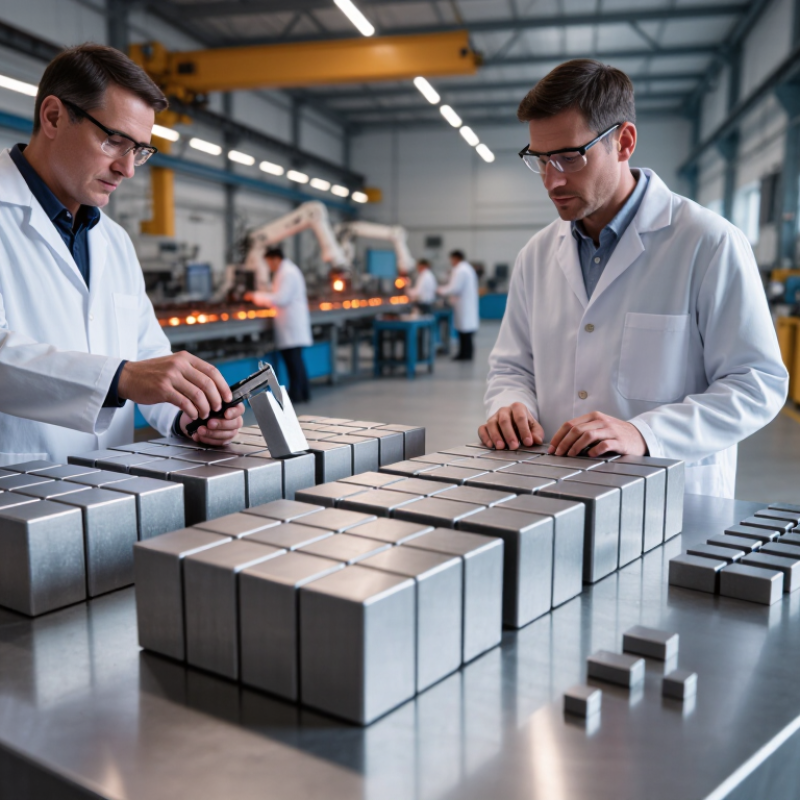
Request samples from the same production route used for mass orders. Check dimensions with calibrated tools, and measure magnetic performance against the agreed specification. I have found that small size errors can cause serious assembly problems. A polished sample can mislead. Review tolerance control, surface finish, coating thickness, and corner damage under normal lighting. Also ask for batch records and material traceability.
Reliable suppliers usually provide inspection reports, production photos, and realistic lead times. Verify whether testing is performed internally or by an independent laboratory. For demanding applications, discuss aging tests, corrosion testing, and maximum working temperature before signing specifications. Communication is another practical test. Can the engineering team understand a drawing, revise a tolerance, and explain a failed sample without vague promises? I once underestimated response time, and the delay affected assembly planning. That experience changed my evaluation method. I now compare documentation quality, process discipline, sample consistency, and technical support alongside cost. The best choice is rarely the cheapest quotation.
China remains the largest source of global rare-earth mine production, an important upstream factor when selecting an NdFeB magnet supplier. The chart shows estimated rare-earth mine production in China compared with worldwide production from 2020 to 2024, measured in thousand metric tons of rare-earth-oxide equivalent. Buyers should also evaluate magnet grade consistency, dimensional tolerance, coating quality, corrosion resistance, delivery capability, and quality-system certifications.